
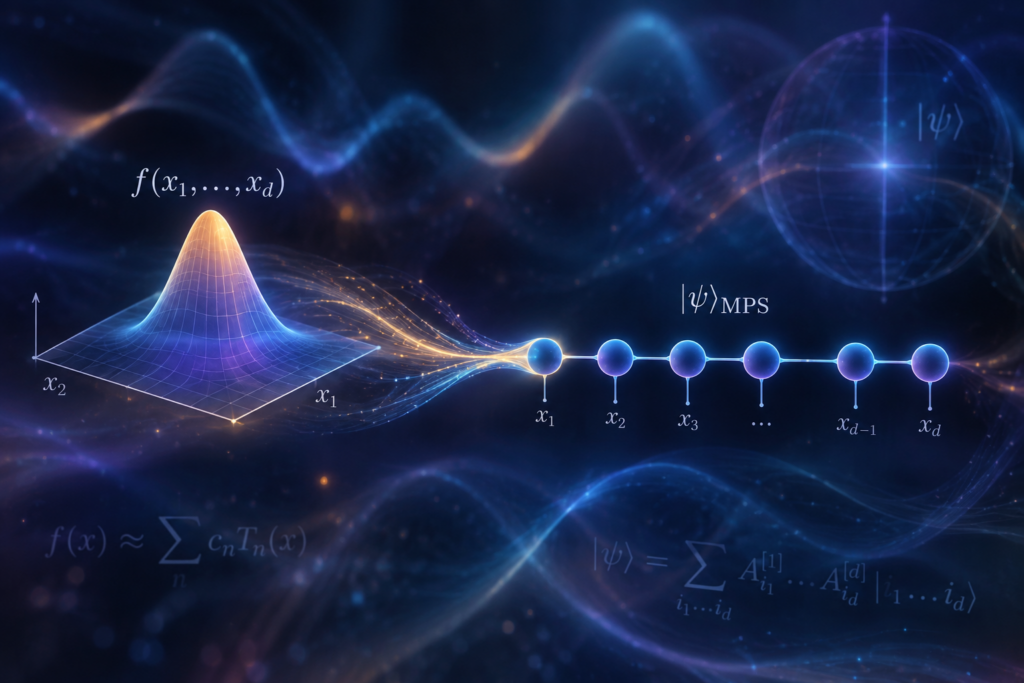
Researchers Juan José Rodríguez-Aldavero, Paula García-Molina, Luca Tagliacozzo and Juan José García-Ripoll, from the CSIC Institute of Fundamental Physics (IFF), have developed a new quantum-inspired algorithm for representing and manipulating extremely large multivariate functions on conventional computers. Their approach is inspired by the way quantum computers store information efficiently. For a special but important class of functions, the algorithm captures some of the advantages of quantum computers, including much faster calculations using exponentially less memory.
The work, published in open access in Linear Algebra and its Applications under the title “Approximation and Composition of Functions in Quantized Tensor Trains via Orthogonal Polynomial Expansions”, uses classical data structures known as tensor networks, which mimic the way information is stored in the qubits of a quantum state. The algorithm combines these networks in a way that produces highly accurate approximations of multivariate functions. To do so, the authors build on a well-known mathematical technique called Chebyshev approximation, widely used for its accuracy and robustness.
The authors tested the algorithm on a collection of high-dimensional numerical examples and observed quantum-style advantages across a wide range of scenarios. These advantages emerged when the functions were very smooth, meaning that they did not contain rapid variations, and when interactions between variables were short-range, with little long-range influence. These are “weakly quantum” functions: if represented on a quantum computer, they would contain only a small amount of quantum entanglement.
The algorithm points toward a new generation of quantum-inspired methods that could help address hard problems that remain beyond the reach of current classical supercomputers. As long as those problems remain weakly quantum, tensor-network algorithms may capture some of the computational advantages of quantum computers while running on today’s conventional hardware. And because tensor networks closely mirror the way information is represented in quantum computers, the same ideas could also inspire future algorithms designed to run directly on quantum hardware.